Dialogbook’s new feature
The SMILE project, which began in 2020, is now in its seventh year. Seven years can seem like a long time, yet it also feels like it has flown by in the blink of an eye.
I have been supporting the project through the development and operation of Dialogbook. This fiscal year, we released Dialogbook version 3 (hereinafter “Version 3”), and after addressing a few bugs, I feel we have reached a reasonably stable state.
Since its initial release in the spring, Version 3 has added several new features, making it even more convenient. A major improvement is the ability to geocode the addresses of participating schools—converting address data into latitude and longitude coordinates—and record that location information. However, because the geocoding service we use isn’t particularly accurate, we had to add a feature that lets users manually pinpoint the exact location on a map. Still, since we are using the geocoder for free, we really can’t complain.
Display of local time
What are the benefits of having access to the location data of participating schools? The main advantage is the ability to automatically determine time zones.
Dialogbook includes features for managing meeting information. While the term “meeting” originally referred specifically to the cross-cultural exchange classes themselves, it has come to encompass all interactions among the parties involved—such as preparatory sessions held by teachers before an online exchange class or post-session reflection meetings. Consequently, the function originally labeled “meeting management” has been renamed “activity management.”
Regardless of the name, a key challenge in organizing cross-border online meetings is time management, mainly because of time differences between countries. For instance, when Japan holds online meetings with partner countries in East or Southeast Asia, a time difference of one to two hours is common (except South Korea).
Time differences create a risk of scheduling errors—such as a participant wondering, “Wait, wasn’t it supposed to be at this time?”—which can jeopardize the meeting itself. Therefore, the SMILE project requires a meeting management system that accounts for these time differences.
With this latest update, Dialogbook automatically identifies time zones based on the participating schools’ locations and displays meeting times according to each school’s local time. While this may seem like a subtle change, it is a highly significant improvement.
Organizing location information for participating schools
Initially, when we began recording location data, we stored location and time zone information in the participating schools table (School). However, we decided it was better not to associate location data directly with the class itself. This was because multiple classes (such as university seminars) from a single school might participate, or a single class might be registered in Dialogbook as multiple distinct classes if participation spanned several academic years.
Consequently, we extracted the location data from the table representing participating classes and stored it in a new table called SchoolSite. This approach makes sense because, regardless of the specific class, all classes from the same school share the same location information—a principle that holds even when participation spans multiple years.
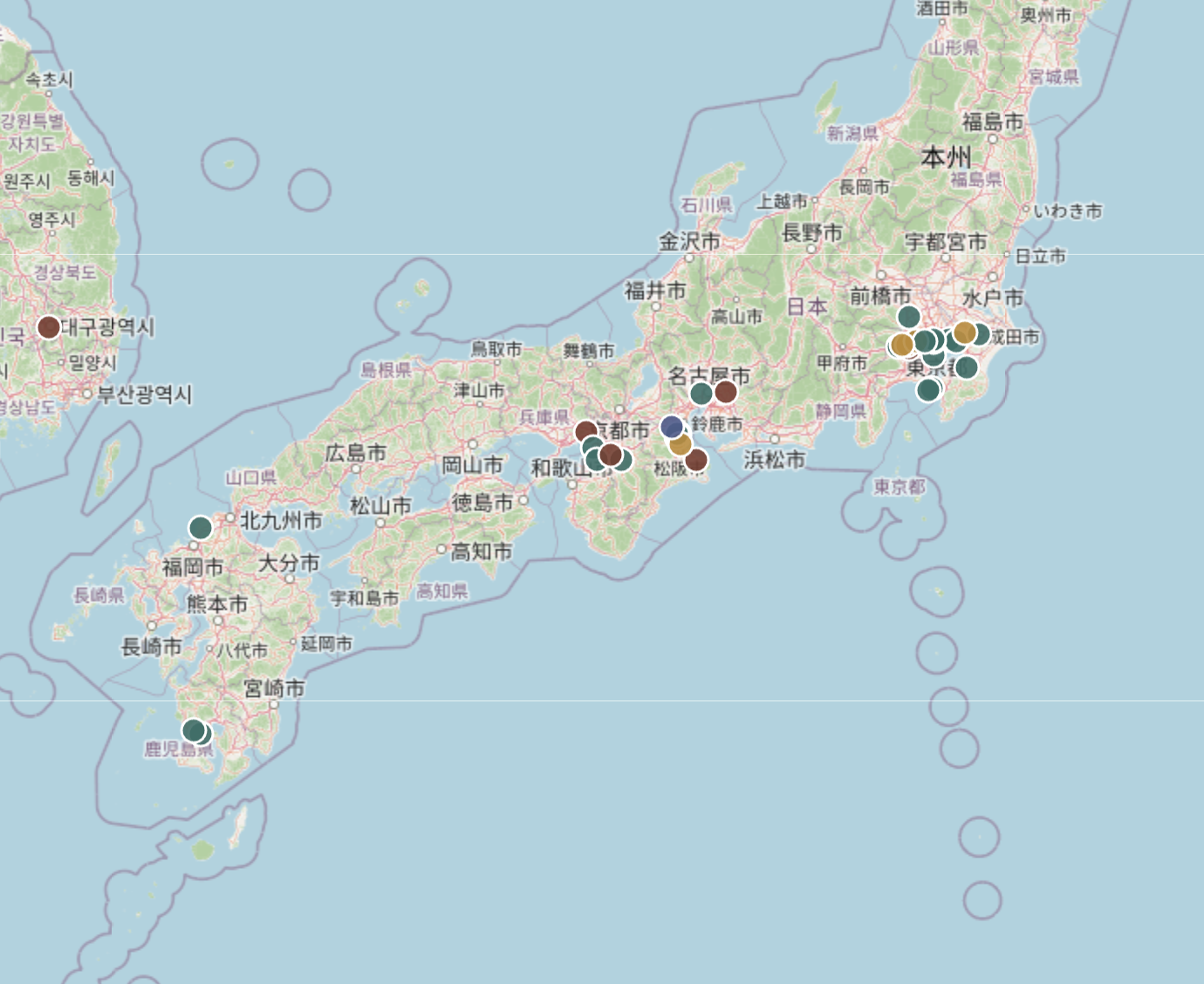
Organizing the data into this SchoolSite table also enabled us to create a map of participating schools. We also included the year each school first participated. The result is the “SMILE Participating Schools Map.”
SMILE Participating Schools Map: https://dlb.kotoba-kobo.jp/school_map.html
Using the slider on the left, you can clearly see how the number of participating schools has grown over the years. For now, our goal is to reach 100 participating schools.